
SpaceX Starship V3 (Ship 39) Successfully Completes Full-Duration Static Fire Test, Advancing Orbital Aspirations
NewsHub
Apr 15, 2026
1 min read
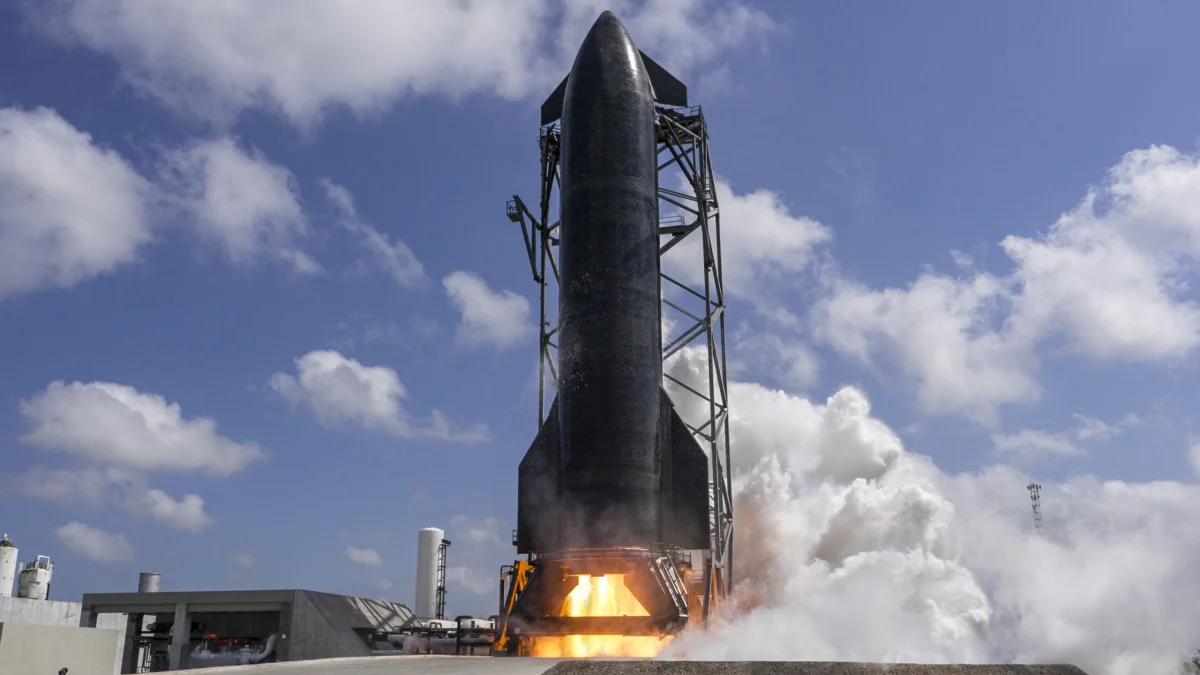
SpaceX has achieved a significant milestone with the successful full-duration static fire test of its Starship V3 prototype, designated Ship 39. All six Raptor engines ignited and operated as intended, validating the vehicle's propulsion system and ground operations. This critical ground test represents a crucial step forward in the iterative development of the fully reusable super heavy-lift launch system. The success de-risks future flight operations and builds confidence in the Starship program's progress towards orbital and deep-space missions, including its role in NASA's Artemis program and long-term goals for Mars colonization.
Key Facts
-
Vehicle Tested Starship V3 (Ship 39)
-
Test Type Static Fire
-
Engines Fired All 6 Raptor engines
-
Test Duration Full duration
-
Outcome Successful
Impact
The successful static fire of Starship V3 (Ship 39) immediately validates critical engineering and operational parameters. It confirms the readiness and robustness of the integrated propulsion system – specifically the six Raptor engines – to withstand the immense forces and thermal stresses associated with a full-duration firing. This successful ground test significantly de-risks upcoming flight test campaigns, bolstering confidence in the vehicle's structural integrity, fuel delivery systems, and engine control sequences, all vital for a future orbital attempt. On a broader scale, this achievement contributes directly to the accelerated development timeline for the Starship program. Each successful test, irrespective of whether it's a ground-based static fire or an atmospheric flight, provides invaluable data that informs design refinements and operational procedures. It reinforces SpaceX's rapid iteration philosophy, propelling the company closer to its goals of routine orbital access, lunar landings as part of NASA's Human Landing System (HLS), and ultimately, human exploration of Mars. This progress is pivotal for the entire space industry, signaling a tangible move towards dramatically reduced launch costs and expanded capabilities.
Key Insights
-
1
Engineering Validation
Confirms the mature performance and reliable integration of the latest Raptor engine iterations within the Starship V3 airframe, indicating robust structural and propulsion system readiness.
-
2
Development Pace
Underscores SpaceX's unwavering commitment to its rapid, iterative development and testing methodology, which continues to drive the Starship program forward at an aggressive pace.
-
3
Strategic Progress
Marks a key checkpoint in preparing Starship for sustained operational flights, critical for Starlink deployments, lunar missions under Artemis, and eventual deep-space human exploration.
Opportunities
The continued success in Starship development opens vast opportunities across multiple sectors. For the space industry, it promises unprecedented capabilities for satellite deployment, enabling the rapid expansion of megaconstellations like Starlink Gen 2 and fostering new opportunities for large-scale scientific payloads and in-orbit manufacturing. The prospect of vastly cheaper per-kilogram-to-orbit costs could democratize space access, stimulating innovation in smaller aerospace companies and academic research. Beyond traditional space applications, Starship's potential extends to point-to-point terrestrial travel, offering rapid transit across continents. Furthermore, its capacity to transport large quantities of cargo and eventually humans to the Moon and Mars creates significant demand for off-world infrastructure development, resource utilization technologies, and closed-loop life support systems. This fosters business opportunities in areas ranging from advanced materials and autonomous construction to regenerative agriculture and specialized robotics, underpinning the foundation for a multi-planetary economy.
Risks & Challenges
Despite this success, the Starship program continues to face inherent risks. While a static fire validates ground performance, the complexities of actual orbital flight introduce numerous new variables, including aerodynamic stresses during ascent and re-entry, in-space engine relights, and precise controlled landings. The high-energy nature of these operations means that even minor component failures or unforeseen environmental interactions could lead to significant setbacks, requiring further redesigns and extensive retesting. Beyond technical hurdles, regulatory challenges, financial pressures, and public perception remain considerable risks. Gaining approvals for an increased launch cadence from environmental and aviation authorities is an ongoing process. The sheer scale of investment required for Starship's full development and operational infrastructure is immense, placing continuous financial demands on SpaceX. Furthermore, any significant failures during flight tests could impact investor confidence, public support, and potentially attract stricter regulatory scrutiny, all of which could lead to substantial schedule delays.
Source url: https://www.nextbigfuture.com/2026/04/spacex-starship-v3-has-successful-static-fire.html
Related Articles